
Artist Statement
Oil Painting empowers me. The medium’s ability to recreate and re-imagine reality is endlessly absorbing. In oils, I can give places and objects a new version of life— one vibrating with an intensity that seems to capture how I feel about the world.
And I usually feel really good about the world— about its malleability, about its endless possibilities for beauty— but art also helps me explore the world’s duplicities and fragilities: chasing beauty can be perilous.
I like to learn how to do everything, and my work has become increasingly vertically integrated— I’m diggig clay from the ground to throw pots to put flowers I grow into beofre I paint them. I dig up bottles to use in still lifes. I pulverize broken glass from our farm’s trash pits to mix with wood ash from our wood stove to make glaze for pots. My work on paper increasingly uses pigments I’ve forged and crafted myself— but I’m no purist— the world is vast, complicated, and I want to understand it all.
I’ve long been interested in the history of domestic space and public space, and particularly in how women navigated these spaces. My academic work focused on how theatrical behavior moved into the 18th Century public sphere in new and surprising ways, and I researched print history, newly forming religious sects, and the behavior of theater-goers. I grew up in a theatrical family, and spent many tedious hours backstage, and the theatrical is one of my lenses— and it emerges in my work as set-like backdrops and in masked figures, and in my understanding of how humans interact with their landscapes, their objects, and each other. My ongoing series of mid-century domestic doyennes with animal heads is an exploration of my own role as erstwhile farmer, as mother, and as wife.
My still life paintings explore prosaic domestic objects, set into conversation with each other. These objects become characters in small domestic dramas— the stone bottle and the battered teapot have had so many heated conversations throughout the years..
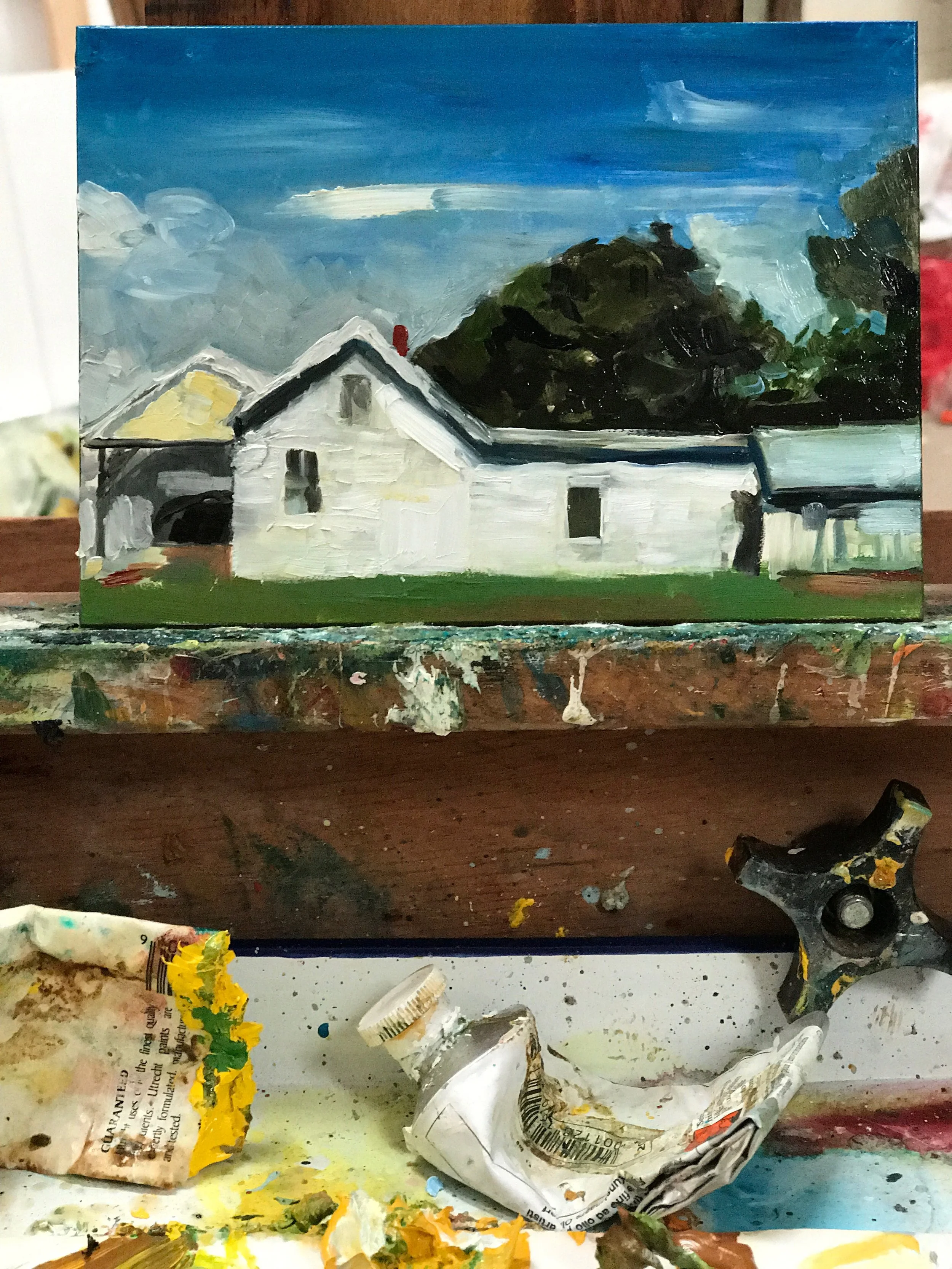
My landscapes, by necessity, are of a land manipulated by humanity— Virginia shows to mark of human hands spreading back thousands of years. We have found artifacts on our farm dating to 7000 years old. The daily changes of the my landscape makes the very act of fixing it feel both fantastic and divorced from reality.
I’m inspired by the fragments of humanity we constantly unearth on our farm, and by the whispers of domestic history we find in our restorations (bat skeletons, wallpaper fragments). The materiality of everyday life has absorbed me for years, and I don’t see it waning. I am honored to be part of the cycle of making domestic objects, helping make domestic spaces more meaningful, and helping the viewer see connections and conversations across time.